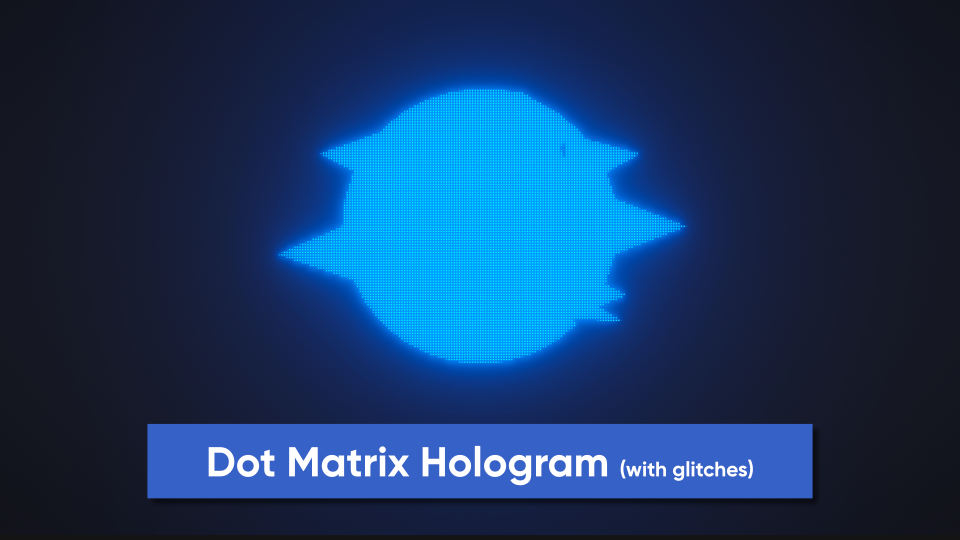
A version of the Dot Matrix hologram which also supports glitches.
Properties
Basic PBR Properties
These properties control the basic interactions between Unity’s lighting and the object. Includes the crucial emissive color settings that control the appearance of the holograms.
- Output Mode - Controls whether the shader outputs color to Base Color, Emission, or both.
- Base Color - Controls the color of the object.
- Base Texture - Also controls the color of the object. This is multiplied by Base Color.
- Normal Texture - Used to change the normal vectors on the surface, which influences lighting interactions. May not be noticeable due to the usage of bright emissive light.
- Normal Strength - A value between 0 and 1 which controls how strongly the Normal Texture impacts the surface normals.
- Alpha Clip Threshold - Any pixel with an output alpha value below this value is culled entirely.
- Metallic - A value of 0 means the lighting on the surface is like a non-metal (wood, paper, plastic). 1 means it is like metal
- Smoothness - A value of 0 means the object is completely rough. 1 means it is highly polished and smooth.
- Ambient Occlusion - A value of 0 means no ambient light reaches the object. 1 means the full ambient light reaches the object.
Vertex Glitches
This type of glitch effect pulls individual vertices of the object to the side (away from the center of the object).
- Use Vertex Glitches - A Boolean value – when on, vertex glitches will be displayed, and when off, vertex glitches are turned off.
- Glitch Sensitivity - How easy it is for a given vertex to fall under the random threshold and start glitching. Higher values mean a lower chance to glitch. This is a value between 0 and 1 that I recommend keeping very high (above 0.99) unless you want a lot of glitches.
- Glitch Normal Multiplier - A multiplier weight value applied to each component of the normal vector for calculating the offsets, e.g. (1, 0, 1) will pull vertices only along the X-Z plane.
- Glitch Strength - How far glitches vertices extend from their original position along their vertex normal.
- Glitch Offset - A time offset – you can use two materials with identical settings except a different offset, and they won’t glitch at the same time.
- Glitch Frequency - How often glitches occur.
Segment Glitches
This type of glitch effect takes a horizontal slice of the object and pulls all the vertices in the slice in a specified direction briefly.
- Use Slice Glitches - A Boolean value – when on, slice glitches will be displayed, and when off, slice glitches are turned off.
- Slice Width - The width, in world space, along the y-axis that the glitch takes up
- Slice Speed - How quickly the glitch effect scrolls down the object
- Slice Frequency - How often glitches occur.
- Slice Jitter - A slight random offset which makes it appear as if the glitch jitters. Probably don’t set it too high or the shader may flash too rapidly (capped to 0.2 by default).
- Slice Duration - How long a slice glitch event occurs for.
- Slice Direction - The direction in which all vertices in the glitch are pulled in world space.
Dot Matrix Pattern
These settings control the density and spacing of the screen-space dots.
- Dot Size - The size, in pixels, of each dot on-screen. All dots are perfectly square.
- Dot Space - The size, in pixels, of the space between dots. The spacing is the same on each axis.
- Rotation Radians - How much to rotate the gridline system, in radians.
Dynamic Resolution
Certain holograms depend on the screen resolution. When using dynamic resolution (FSR or DLSS), Unity sometimes uses the pre-upscaling resolution in shaders, resulting in incorrect results for some shaders. These properties let you adjust the resolution used in shaders.
- Upscaling Amount - When using dynamic resolution (FSR or DLSS), it may help to modify this setting to ensure the scaling of the dot pattern remains constant.