Shader Toolbox for URP comes with an extensive collection of subgraphs which make your life easier when creating your own graphs. Many of these are used to fuel the shaders which are bundled with the pack.
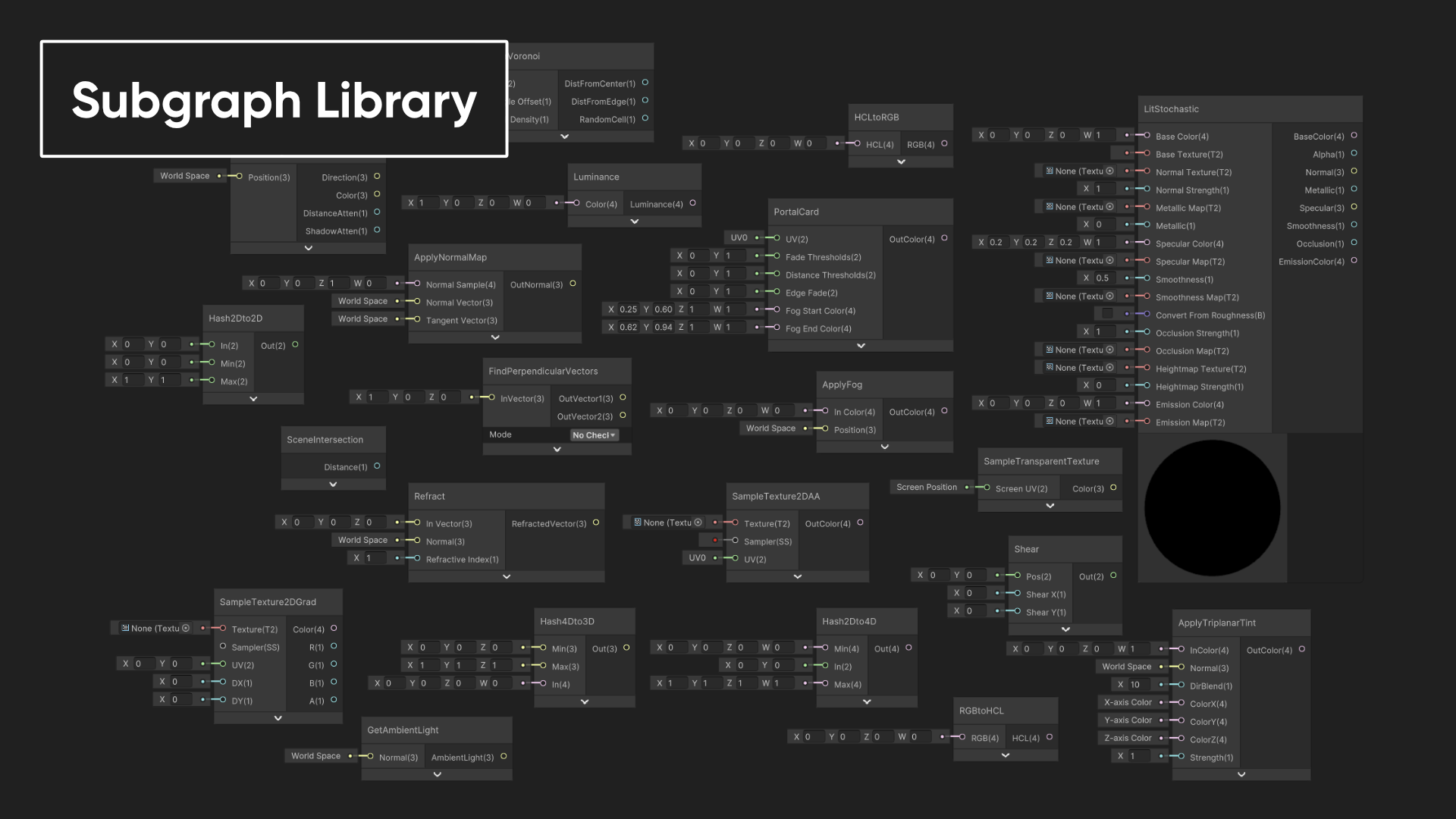
Subgraph List
Color
- Blend HCL - Lerp between two RGB input colors in HCL color space.
- Blend HSV - Lerp between two RGB input colors in HSV color space.
- HCL to RGB - Converts from Hue-Chroma-Luminance color space to Red-Green-Blue.
- RGB to HCL - Converts from Red-Green-Blue color space to Hue-Chroma-Luminance.
- LCD Screen - Splits the input texture into red, green, and blue subpixels, with a horizontal scanline and a smoothing parameter.
- Luminance - Converts an RGB color into a single greyscale value, taking into account the relative sensitivity to the three kinds of light.
Fog
- Apply Fog - Takes in a base color and world position, and outputs the fog color applied to the base color.
- Portal Card - Calculate a fade color based on the distance of the camera from the object. Based on an effect from the game Abzû.
Lighting
- Apply Triplanar Tint - Overlay three colors along the cardinal X-, Y-, and Z-axes based on the surface normal.
- Get Ambient Light - Gets ambient light data from spherical harmonics.
- Get Main Light - Retrieve data from the main light, such as the direction (as with the Main Light Direction node), color, shadow attenuation, and distance attenuation.
- Lit Default - The main subgraph which combines Lit properties and outputs values you can output to the graph output stack.
- Lit Default LOD - Same as Lit Default, but with an extra parameter to use a specific mip level (LOD) to sample each texture.
- Lit SPOM - Same as Lit Default, but it uses Silhouette Parallax Occlusion Mapping.
- Lit Stochastic - A version of the Lit Default subgraph which also applies stochastic texture sampling to each texture map, disrupting obvious texture tiling.
- Matcap - Maps a texture based on the surface normal vector. The matcap texture should encode lighting and color information.
Noise
- Better Voronoi - A new version of the Voronoi node which outputs pixel distance from the nearest edge between cells (as well as the distance from the cell center point, as the built-in Voronoi node does).
Random
- Hash {1-4D} to {1-4D} - Uses the input as a seed value for a random function which outputs a value. Both the input and output can be any vector between 1 and 4 elements in length, for 16 unique subgraphs.
Texture
- Apply Normal Map - Takes in a normal map and applies its normal data to the world normal vector to produce a combined vector.
- Resolution Limit - Uses the mip maps of a texture to reduce its resolution.
- Sample Stochastic - Sample a texture with random UV offsets to reduce texture tiling.
- Sample Texture2D AA (Anti-aliasing) - Sample a texture with anti-aliasing wherever the texels take up several on-screen pixels.
- Sample Texture2D Grad - A version of Sample Texture 2D which lets you manually supply gradient vectors.
- Sample Transparent Texture - Samples the
_CameraTransparentTexture. If this isn’t set up (see Camera Transparent Texture for details), then it will output a grey texture instead. - Silhouette Parallax Occlusion Mapping - Apply parallax occlusion mapping with an added step where the edges of the mesh get alpha-clipped based on parallax height.
Utility
- Scene Intersection - Calculate the difference between the distance of the object being drawn and the distance of the object in the scene depth texture.
- Smoothstep Between - Perform two smoothstep functions to return a new kind of smoothstep with both lower and higher threshold windows.
- Step Between - Perform two step functions, returns 1 whenever the input is between the lower and upper thresholds.
Vector
- Find Perpendicular Vectors - Given a single vector input, this node finds two vectors which are perpendicular to that vector (and to each other), with a safety mechanism if the zero vector is input.
- Normal Displacement - Apply a displacement along the normal vector direction to a given position.
- Refract - Outputs a refracted vector given an input vector, a surface normal, and a refractive index.
- Shear - Distort an object along one axis based on its distance along the perpendicular axis.